

From Automation to Autonomy: The Next Phase of ERP Transformation
Enterprise Resource Planning systems have been central to business operations for decades. They connect finance, supply chain, procurement, and operational processes within a unified platform. However, the way organizations use ERP systems is evolving rapidly.
The next phase of ERP digital transformation is shifting enterprise systems from simple automation toward autonomous operations. This transformation is driven by advancements in artificial intelligence, data integration, and process orchestration.
Organizations are no longer satisfied with ERP systems that simply record transactions. They want systems that help manage operations, identify risks, and respond to business conditions automatically.
To understand this ERP automation strategy, it is useful to examine the stages organizations typically pass through as they move from manual operations to intelligent and autonomous ERP environments.
Stage 1: Manual Processes in Early ERP Environments
Before automation became widespread, many ERP activities relied heavily on manual intervention. Employees entered data into systems, reconciled financial records, monitored inventory levels, and coordinated operational tasks through emails or spreadsheets.
While ERP platforms helped centralize business information, operational workflows still depended on human effort.
Typical characteristics of manual ERP operations included:
-
Repeated data entry across multiple systems
-
Manual approval processes
-
Spreadsheet-based reporting and analysis
-
Delayed operational visibility
-
Slow response to operational disruptions
These limitations created inefficiencies and increased the risk of errors. As organizations expanded and transaction volumes increased, manual processes became unsustainable.
This challenge led companies to explore automation within ERP environments.
Stage 2: Workflow Automation in ERP Systems
The next stage of ERP evolution introduced workflow automation. Organizations began implementing rule-based processes to reduce manual intervention.
Workflow automation typically includes:
-
Automated invoice approvals
-
Purchase order workflows
-
Scheduled reporting processes
-
Automated inventory replenishment triggers
-
Standardized business process approvals
These capabilities form the foundation of many ERP automation strategies today. By automating repetitive tasks, organizations can improve efficiency and reduce operational errors.
However, traditional workflow automation still relies on predefined rules. Systems execute actions only when specific conditions are met. If unexpected situations arise, human intervention is required.
For example, a purchase order approval workflow may function smoothly under normal conditions. But if pricing discrepancies or supplier issues occur, the process often stops until someone manually reviews the situation.
Workflow automation improves efficiency but does not fully address operational complexity.
Stage 3: Intelligent ERP Automation
The next phase of ERP digital transformation introduces intelligence into automated workflows.
Instead of relying solely on predefined rules, intelligent automation incorporates machine learning, predictive analytics, and advanced data processing.
This approach enables ERP systems to interpret operational patterns and support more complex decision-making.
Examples of intelligent ERP automation include:
-
Predictive demand forecasting
-
Automated anomaly detection in financial transactions
-
AI-assisted reporting and analysis
-
Intelligent inventory planning
-
Process optimization recommendations
In this stage, ERP systems begin to assist users rather than simply execute predefined tasks.
For instance, finance teams can use intelligent ERP systems to identify unusual transaction patterns automatically. Supply chain teams can receive predictive alerts about potential inventory shortages.
These capabilities significantly enhance operational awareness.
However, intelligent automation still depends heavily on human decision-making. Systems can identify issues and recommend actions, but people must ultimately decide how to proceed.
The next stage introduces a more advanced level of operational capability.
Stage 4: Agentic ERP and Autonomous Operations
The emerging stage of ERP transformation is known as agentic ERP.
In this environment, AI agents operate within ERP systems to monitor operational conditions and execute workflows automatically. These agents analyze data, evaluate potential actions, and carry out tasks within defined governance rules.
This represents a shift from assistance to execution.
Instead of only identifying problems or generating recommendations, ERP systems can initiate responses to operational events.
For example:
An AI agent monitoring supply chain operations might detect declining inventory levels. It could analyze demand forecasts, evaluate supplier performance, and generate a purchase order automatically. If required, the system can also initiate approval workflows based on company policy.
Similarly, finance operations can benefit from automated reconciliation agents that investigate discrepancies and resolve routine issues without manual intervention.
Agentic ERP environments combine:
-
enterprise data intelligence
-
workflow orchestration
-
AI-driven decision support
-
automated execution capabilities
This combination allows ERP systems to operate more proactively.
Organizations move from reactive operational management toward systems capable of continuous monitoring and response.
Why ERP Automation Strategy Matters
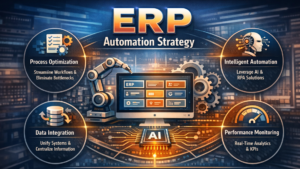
Transitioning toward autonomous ERP systems requires a well-defined ERP automation strategy. Many organizations attempt to introduce advanced automation technologies without first addressing foundational operational challenges. Successful ERP transformation typically involves several key elements.
Process Standardization
Organizations must establish consistent workflows across departments before implementing automation. Inconsistent processes create confusion for automated systems.
Data Governance
Reliable data is essential for intelligent automation. Master data management, data validation processes, and clear ownership structures help ensure accurate decision-making.
Integration Architecture
ERP systems rarely operate in isolation. They connect with CRM platforms, e-commerce systems, logistics tools, and analytics platforms. Effective integration ensures AI agents have access to the information required to perform operational tasks.
Governance and Oversight
Even in autonomous environments, organizations must maintain clear approval structures and audit trails. AI agents should operate within defined policy boundaries.
When these elements are aligned, organizations can implement intelligent ERP automation with greater confidence and stability.
Benefits of Moving Toward Autonomous ERP
Organizations that successfully evolve toward agentic ERP systems gain several operational advantages.
Faster Operational Response
AI agents can detect operational disruptions and initiate corrective actions faster than manual monitoring.
Improved Efficiency
Routine operational tasks can be handled automatically, allowing employees to focus on strategic work.
Enhanced Decision-Making
Continuous data analysis provides deeper insights into operational performance.
Greater Scalability
Autonomous workflows allow organizations to manage increasing transaction volumes without proportionally increasing manual workload.
These benefits highlight why many enterprises view intelligent ERP automation as a key component of their long-term digital strategy.
The Future of ERP Digital Transformation
ERP technology is moving beyond its traditional role as a system of record.
In the future, ERP platforms will increasingly function as intelligent operational environments capable of coordinating complex workflows across the organization.
Artificial intelligence, automation, and integration platforms will continue to enhance ERP capabilities.
Organizations that adopt a structured ERP automation strategy today will be better positioned to transition toward autonomous enterprise operations.
The journey from manual processes to agentic ERP will not happen overnight. It requires careful planning, strong governance, and a clear understanding of operational priorities.
However, the direction is clear.
ERP systems are evolving from platforms that simply track business activity to platforms that actively help run the business.
For organizations pursuing ERP digital transformation, the shift from automation to autonomy represents the next major milestone in enterprise technology.