


Why AI Alone Won’t Transform Your Business: The Importance of Process-First Thinking
Get that sequence wrong, and the AI investment doesn’t just underperform — it can make existing problems more visible, more expensive, and harder to walk back from. At DAX Software Solutions, we help organizations get the sequence right: stabilize the operational foundation, then apply Microsoft Dynamics 365 and Agentic AI capabilities on top of it — not the other way around.
The AI Investment Boom — and the Silent Failure Rate
Capital is flowing into AI faster than most organizations can absorb it responsibly, and the return on that capital is proving uneven. Gartner projected that at least 30% of generative AI projects would be abandoned after proof of concept by the end of 2025, citing poor data quality, inadequate risk controls, escalating costs, and unclear business value as the leading causes.
Notice what isn’t on that list: the sophistication of the model. The failures Gartner points to are foundational — data, governance, and business clarity — not the AI itself. That is the decision point leaders keep missing: the choice to adopt AI is really a choice about whether the operational foundation underneath it is ready to support it.
Why Technology Alone Can’t Fix a Broken Process
[Image: why-technology-alone-cant-fix-a-broken-process.png — Executive reviewing a fragmented process map with disconnected system icons, representing how AI exposes rather than fixes broken business processes]
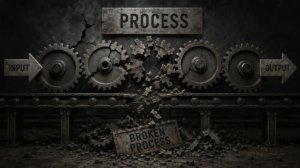
An AI model — however capable — inherits whatever it’s connected to. If the underlying process is inconsistent, the exceptions unmanaged, and the data fragmented across systems, AI does not quietly correct that. It surfaces it, at scale and at speed.
This shows up as:
- Automated recommendations built on stale or duplicate data, so the output looks precise but isn’t trustworthy.
- Faster processing of an exception queue that was never actually resolved — just accelerated.
- Dashboards and copilots reflecting three versions of “the truth” because finance, sales, and operations systems were never reconciled.
Microsoft makes a similar point directly: in describing the shift toward agentic business applications, Microsoft states that “technology alone isn’t enough. Business transformation requires functional leaders to align processes with these new capabilities” — with “structured data, clear governance, and business logic” as the foundation those capabilities depend on. That’s not a caveat. It’s the central condition for AI to deliver anything at all.
The Real Cost of Sequencing It Wrong
The cost of adopting AI before the process is ready isn’t limited to a failed pilot. It compounds in three ways that matter directly to the executives who own the budget:
- Wasted capital — licensing, integration, and change-management spend attach to a foundation that can’t support the use case, and the investment has to be redone once the process work finally happens.
- Eroded internal trust — once a business unit sees an AI recommendation based on bad data, skepticism spreads to future initiatives, even well-designed ones.
- Compliance and governance exposure — autonomy layered onto ungoverned processes creates decisions no one can fully explain after the fact, a real risk in regulated industries.
None of this means AI is the wrong bet. It means the sequencing decision — process first, AI second — is the one that actually protects the investment.
The Process-First Playbook: Four Steps Before AI

[Image: the-process-first-playbook-four-steps-before-ai.png — Four-step framework diagram showing ERP assessment, process stabilization, data governance, and system integration as the sequence before AI enablement]
Integration comes before intelligence: AI can’t help while systems are disconnected and data is fragmented, because a model can only act on what it can see, and it can only be trusted to act on what’s accurate. DAX sequences the work required before AI enablement into four steps:
- Assess — an AI Readiness Assessment evaluating ERP stability, data quality, governance maturity, and integration across the systems that would feed an AI initiative.
- Stabilize — reconciling process variation across business units and resolving the manual workarounds that would otherwise get automated as-is.
- Govern — establishing data governance and master data management, so ownership, validation, and a shared definition of key business entities exist before AI touches the data.
- Integrate — connecting ERP, CRM, finance, and operational systems, including through DAX’s Aonflow integration platform, for near real-time data sync across the organization.
Executives who follow this sequence aren’t moving slower than peers chasing AI-first headlines — they’re building something the AI investment can actually stand on.
Where Agentic AI Fits — After the Foundation Is Ready
Only once assessment, stabilization, governance, and integration are in place does Agentic AI enter the picture. DAX’s Agentic ERP Strategy & Advisory and Agentic AI Adoption Framework help organizations identify where intelligent automation can responsibly close a gap once the foundation supports it — evaluating readiness before recommending where autonomy should be introduced.
This is also where Microsoft’s own platform investment is heading: Dynamics 365 now includes agents such as the Account Reconciliation Agent and Supplier Communications Agent, built to operate on top of structured, governed data within the Dynamics 365 environment. Those capabilities belong to Microsoft’s platform roadmap — DAX’s role is advising on and implementing where and how they fit an organization’s specific process and governance requirements, not selling a proprietary AI product of its own.
Governance: Controlled Autonomy, Not Uncontrolled Automation
Speed without oversight isn’t transformation — it’s just faster exposure to risk. Human-in-the-loop operating models, where AI and people collaborate under clearly defined boundaries, are what separate controlled autonomy from uncontrolled automation.
This mirrors the emphasis of the NIST AI Risk Management Framework, which builds governance and human oversight into every stage of the AI lifecycle rather than treating them as optional add-ons. A well-governed decision is one an organization can afford to make quickly — which is exactly why governance and speed aren’t in tension when the sequence is right.
DAX Software Solutions: Your Partner in Process-First AI Readiness
The organizations that get the most from AI in the years ahead won’t be the ones that adopted it first. They’ll be the ones that built the operational foundation strong enough to support it — connected systems, governed data, and stable processes — before asking AI to operate on top of them.
DAX Software Solutions helps organizations make that decision correctly, through:
- AI Readiness Assessments that evaluate ERP stability, data quality, and governance before any AI investment is made.
- A structured Agentic AI Adoption Framework — stabilization, governance, integration, then AI enablement — so speed is built on solid foundations.
- Human-in-the-loop operating models that pair automation with the oversight leadership and regulators expect.
If your organization is weighing where to place its next AI investment, the decision that matters most may not be which tool to buy — it’s whether the process underneath it is ready. Talk to DAX Software Solutions about building that foundation first.